What is white label file sharing and how it works
The six layers you can brand, how white label differs from branding, and which Tarkle plan fits each case.

What is white label file sharing? It is a file sharing service that carries your name, logo, colors and web address instead of the vendor's, so your clients see your platform and not a third party's. The vendor still runs the storage and the software behind the scenes; you put your brand on the front.
The term gets used loosely. Some tools call a logo upload "white label", others mean a platform your clients sign in to on your own domain. This guide explains the meaning, the layers you can brand, how white label differs from plain branding, who resells it, and what to ask a provider before you pay.
White label file sharing meaning: the six layers
Think of white label as a stack of layers. A provider can cover some of them and not others, which is why two tools can both say "white label" and behave very differently.
Name. What clients read in the page title, the footer and the "Powered by" line. On the Free plan, Tarkle keeps a "Powered by Tarkle" line on public pages. On a monthly or yearly Pro plan you can turn that line off. On Agency, the backlink becomes your agency name once White label is switched on.
Logo and favicon. Your logo on the transfer page, the file request page and the portal, and your favicon in the browser tab. See custom branding.
Colors. An accent color for your pages.
Domain. Links open on an address you own, such as files.yourstudio.com, not on the vendor's address. Free includes a custom domain. See custom domain and how to use a custom domain for your file sharing links.
Emails. Notification emails come from your domain, not the vendor's. This layer is on Pro and Agency. See send email from your own domain.
Sign-in. The page where clients log in. In a client portal, each client signs in with their email and sees only what you shared with them.
Open a test link in a private window and read it as a client would: address bar, tab title, footer, the first email, the sign-in page. Whatever still names the vendor is a layer you have not covered.
For a walk through the first four layers, read branded file sharing links: four layers to set up.
Branding vs white label: what is the difference?
Branding changes how a link looks. You add a logo and a color, and the page looks like yours, but the platform may still say who runs it. White label goes further: the vendor's name is replaced across the places clients see, and the client logs in on your domain.
In practice the line is the vendor's own name. Custom domains are available on every plan. Free and Pro give you branding. Agency is the plan where the platform is white label: clients log in on your own domain, and the "Powered by Tarkle" backlink becomes your agency name. White label works only while the Agency plan is in force and the owner has switched it on. The white label for agencies page lists what changes.
Be honest with yourself about which one you need. If clients only receive a link now and then, branding on one custom domain may be enough. If clients return, sign in and manage their own files, white label is worth paying for.

Who sells white label file sharing?
Three groups, with different jobs:
Agencies and studios use it for their own clients. They are customers of the vendor and bill clients for their own work.
IT providers, MSPs and web hosts use it to add file sharing to what they already sell.
Resellers sell the platform itself under their own name, with their own plans and prices.
The vendor side is crowded, and the word "white label" does not tell you what is covered. Read each vendor's own page for the layers it brands and the plan each one needs.
If you want to sell rather than use it, read how to resell cloud storage under your own brand.
Questions to ask a provider before you pay
Put these to every vendor:
Which of the six layers are covered, and on which plan?
Does the vendor's name still show anywhere a client can see, such as a footer, an email or a legal page?
Can clients sign in on my domain, and what does the sign-in page look like?
Do emails come from my domain, and how is that domain verified?
How many client workspaces are included, and is storage shared or split per client?
What happens to my clients if my plan ends or a payment fails?
Who bills my clients, and who owns the relationship?
Where are the files stored, and can you choose the region?
On Tarkle, workspace files are stored in one of four regions, and you choose the region when you create a Workspace: European Union, United States, Hong Kong (Asia Pacific), or Australia (Oceania).
On Agency, when the plan ends, or a payment fails and is not fixed, your organization moves to Free and extra workspaces are switched off. White label stops. A switched-off workspace is suspended, not deleted, and its files are not removed.
Ask for the answer about plan endings in writing, and tell your clients what happens to their files before you onboard them.
The reseller terms answer several of these for resellers. Surfaces that customers see carry the reseller's brand and do not show Tarkle's name or logo, with one required attribution in the legal pages. The reseller must tell its customers that access may end if its Tarkle subscription ends, and must not describe the platform as technology built entirely by the reseller. The Reseller Dashboard keeps Tarkle branding, and end users do not see it.
Where Free, Pro, Agency and Reseller fit
Prices below come from the pricing page and the reseller page.
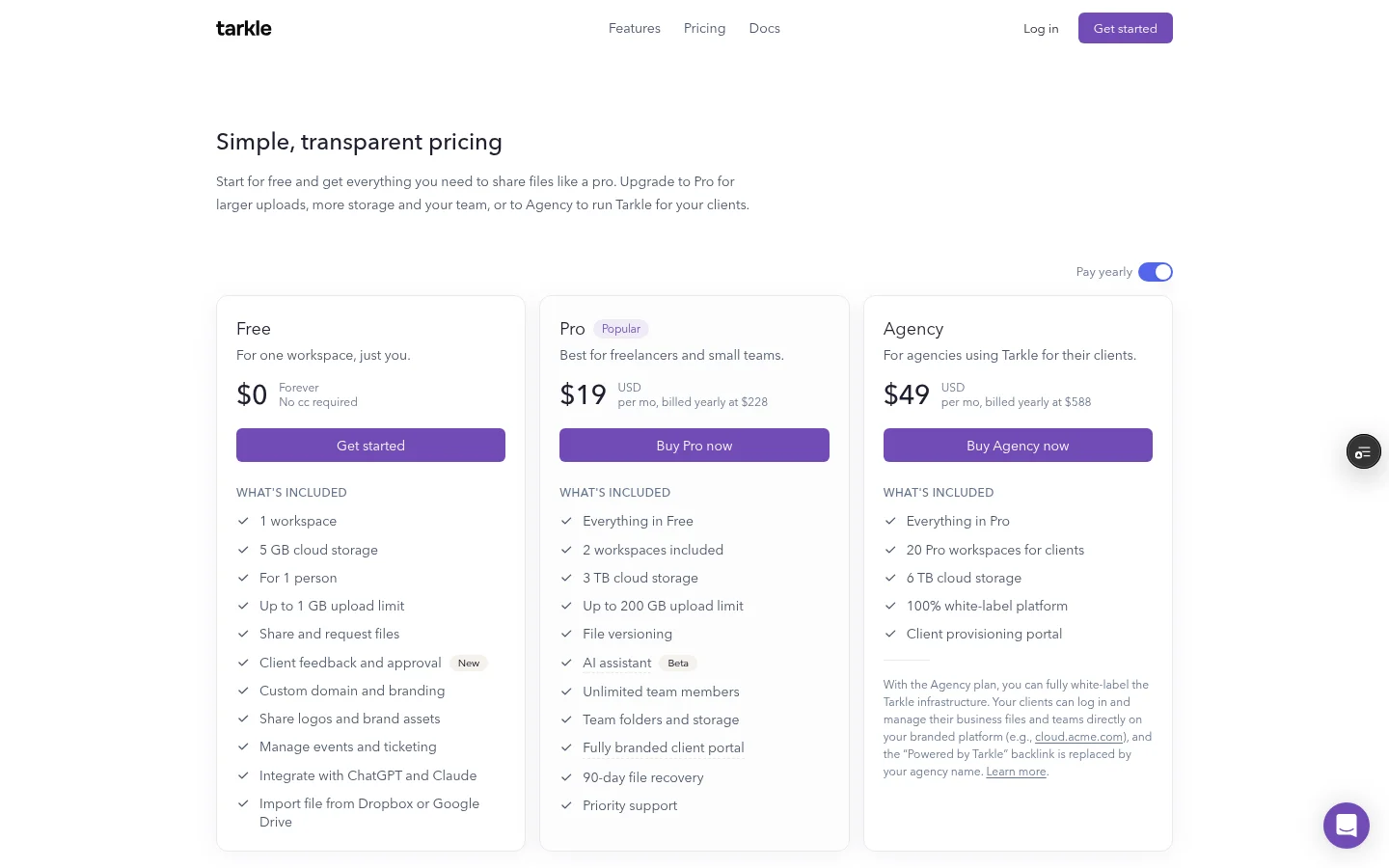
Free is $0 with no card. It gives you 1 workspace for 1 person, 5 GB of storage, uploads up to 1 GB, file sharing (15 transfers a month), file requests (1 active request form and 50 submissions a month), client feedback and approval, custom branding and a custom domain. It is enough to test the layers on your own links. The Powered by Tarkle line stays on Free pages, and Free stops at one person and one workspace.
Pro is $29 a month, or $19 a month billed yearly ($228 a year). It adds 2 workspaces, 3 TB of storage, uploads up to 200 GB, unlimited team members, file versioning and a fully branded client portal. On a monthly or yearly Pro plan you can turn off the Powered by Tarkle line. Pro is the better fit when clients need to sign in and see only their own files, and you are one business with a few clients.
Agency is $59 a month, or $49 a month billed yearly ($588 a year). Agency includes everything in Pro. It adds 20 workspaces for your clients, 6 TB of shared storage, a 100% white-label platform and a client provisioning portal. Agency fits when each client needs a workspace of their own. Give a client workspace its own storage amount from the Dashboard, so it cannot use your whole shared pool.
Reseller is for selling the platform under your own name. It costs $99 a month plus a one-time $99 setup fee, or $89 a month billed yearly ($1,068 a year), and yearly billing has no setup fee. It includes everything in Pro and Agency. It adds 50 customer workspaces, 6 TB of pooled storage and one authorized sales territory. You set your own plans and prices with Stripe.
Reseller Pro is $189 a month plus a $189 setup fee, or $179 a month billed yearly ($2,148 a year), with 100 customer workspaces, 15 TB of pooled storage and up to three authorized sales territories.
For anything beyond the listed plans, contact support@tarkle.com and we'll review what you need.
What to remember about Tarkle
Free gives you custom branding and a custom domain. Pro adds a fully branded client portal and lets you turn off the Powered by Tarkle line. Agency gives you a white label platform on your own domain. Reseller is for selling the platform under your own name, with your own plans and prices. Test the layers on Free first, then Start for free.